
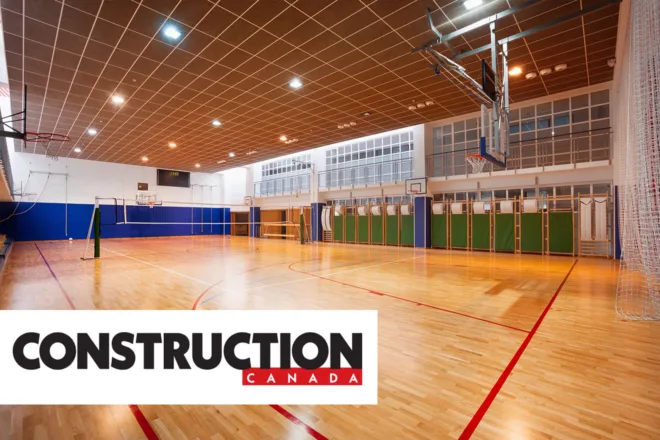
*This article by INSTALL executive director David Gross was originally featured in Construction Canada.
Specifying Gym Flooring Systems: Balancing Performance, Versatility, and Durability in Multi-use Spaces
Entering a school or community centre gymnasium today, one is likely to find a space used for far more than basketball practice. In elementary and secondary schools, the gym or multipurpose space, sometimes called a “cafetorium,” may serve as a physical education classroom in the morning, cafeteria at lunchtime, and assembly space in the afternoon.
For architects, designers, and specifiers, the expanding definition of the gymnasium has direct implications for flooring system selection. The chosen material must deliver appropriate shock absorption, surface uniformity, traction, and ball response for game play. It must also withstand heavy foot traffic, rolling bleachers, staging, and sound systems. Add in the installation environment, esthetic expectations, maintenance requirements, and lifecycle costs, and the decision-making process becomes increasingly complex.
For gymnasium floors, design teams can choose from maple hardwood, sports vinyl, rubber, and pour-in-place flooring systems, but they must take special care to ensure their chosen system is up to the task. This means evaluating the material’s composition and performance characteristics, as well as its best uses and installation implications. To guide and inform this process, the following explores the unique characteristics of four of the most common gymnasium flooring materials. It offers a checklist for planning and selecting a flooring system to ensure success.
Flooring types and applications
The first step in choosing a gymnasium flooring system is understanding the form and function of each material and its performance characteristics, as these features inform the best uses of the material and highlight installation requirements.
Maple hardwood
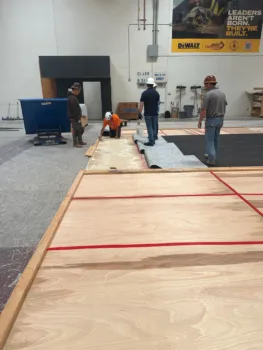
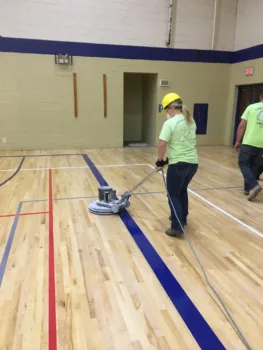
Maple hardwood flooring is made from solid maple planks installed over a resilient subfloor. The planks are typically sanded, finished, and sealed on-site to create a smooth, continuous surface. The underlying subfloor is engineered as an area-elastic system, so when a load is applied, such as a player jumping, the floor flexes slightly across a wider area rather than just beneath the point of contact. How that load is distributed is determined by the subfloor design, pad spacing, and other installation details, such as the thickness of the plywood layers and the spacing and orientation of the sleepers beneath.
Maple sports gym floors are not just maple hardwood fastened to a subfloor. They are engineered performance systems designed to function as a complete, integrated assembly. Each component—subfloor construction, resilient system design, wood flooring, fastening method, moisture control, surface preparation, sanding, finishing, and game line application—contributes to how the floor performs under athletic use. The maple surface is the wear layer. The system underneath dictates performance.
Performance characteristics: Maple hardwood is widely recognized as the standard for competitive court sports. Its predictable ball response, traction, and energy return support athlete agility and reduce physical fatigue. The areaelastic system distributes impact over a wider surface area to enhance safety and comfort. When properly installed, protected from slab moisture, and maintained within prescribed temperature and humidity ranges, maple floors are extremely durable and can perform at a high level for decades, providing both reliability and consistency.
Best uses: Maple hardwood is ideal for facilities where competitive court performance is a priority, including secondary schools (Grades 9-12), colleges, and universities seeking continuity of surface quality across athletic programs. Its superior ball response and traction make it the preferred choice for basketball, volleyball, and other performance-driven sports. For multipurpose gymnasiums hosting assemblies, concerts, community events, or cafeteria functions, maple hardwood can be used, but with caveats. Heavy rolling equipment, staging, or frequent nonsport use can increase wear and the risk of surface damage and may require protective measures such as temporary floor coverings. Facilities that prioritize versatility over competitive performance may find other systems more forgiving and easier to maintain in multi-use scenarios.
Installation implications: Achieving the full performance potential of maple hardwood depends on the precise installation of the subfloor system. The structural support, typically plywood or engineered sleepers, provides stability and ensures loads are evenly distributed. Rubber or foam pads embedded in the subfloor create the controlled flex required for area-elastic behaviour and shock absorption.
Before beginning subfloor work on a concrete slab, moisture testing with in-situ probes should be performed to confirm that slab conditions are appropriate for installation. Verifying moisture conditions in concrete slabs is essential for protecting manufacturer warranties and reducing the risk of moisturerelated failure, as well as for limiting installer liability.
If moisture readings exceed manufacturer limits, steps must be taken to address the cause (e.g., enclosing the installation space or operating the HVAC), and the area must be retested until it is within the specified range.
Moisture measurement, interpretation, and documentation are governed by a standardized set of protocols based on ASTM F06 710, Standard Practice for Preparing Concrete Floors to Receive Resilient Flooring, which designates ASTM F2170, Standard Test Method for Determining Relative Humidity in Concrete Floor Slabs Using in situ Probes, as the primary test method and permits ASTM F1869, Standard Test Method for Measuring Moisture Vapor Emission Rate of Concrete Subfloor Using Anhydrous Calcium Chloride, as a supplemental test.
These standards specify the required documentation for test locations, dates, and results. Together with manufacturer specifications, they establish the minimum requirements for verifying concrete slab moisture conditions and confirming suitability for installation.
Moisture barriers and levelling compounds can then be applied to further protect the hardwood from slab moisture and ensure a flat, uniform surface. At the same time, screws or adhesives secure the layers without restricting the slight movement necessary to prevent squeaks or gaps. Additional layers may be incorporated to reduce sound transmission or enhance underfoot comfort. Attention to these details is critical, as improper subfloor construction or environmental control can compromise energy return, ball response, and the long-term durability of the finished hardwood surface.
Sports vinyl flooring
Sports vinyl flooring is a resilient sheet or tile material typically composed of multiple layers, including a wear layer, a backing layer, and an integrated cushioning layer. Some products also incorporate a thin foam or felt underlayer to enhance shock absorption and comfort. The finished surface is either seamless (sheet) or installed in large, flat sections (tile), providing a uniform appearance across the gym floor. In contrast to maple hardwood, sports vinyl is a point-elastic system, meaning it flexes primarily at the point of impact rather than distributing force across a wider area.
Performance characteristics: Sports vinyl offers high levels of shock absorption, underfoot comfort, and surface uniformity, making it well-suited for recreational and lower-level competitive play. Vinyl systems are generally not preferred for high-level competitive sports such as basketball and volleyball, but flooring system standards vary among domestic and international governing bodies, and they may be accepted in some cases. While the gold standard for competitive basketball is a maple sports floor system, vinyl systems are more suitable for general use and are not considered high-performance floors. Its point-elastic behaviour helps reduce impact forces on athletes while maintaining predictable traction for indoor sports. Vinyl is strong and durable, but slightly softer underfoot than rubber flooring, providing enhanced comfort for running, jumping, and lateral movements. It offers a wide range of colour and surface options, integrating high athletic performance with esthetic considerations.
Best uses: Sports vinyl is particularly suited to gymnasiums that combine athletic programming with multipurpose use, such as schools, community centres, private athletic clubs, and churches. Its combination of shock absorption, comfort, and durability makes it ideal for assemblies, conferences, social events, and other non-athletic programming. While it is appropriate for multi-use events, it is better suited for spaces where athletic performance and comfort are prioritized over maximum durability under heavy rolling loads, extreme traffic, staging, or chair handling are expected, as these conditions can accelerate surface wear and seam stress.
Installation implications: Proper installation of sports vinyl requires a smooth, level, and moisture-free subfloor to ensure adhesion or proper alignment of sheets or tiles. Some systems are fully adhered, while others float over an underlay to enhance cushioning. Seams must be expertly welded or sealed for a continuous surface, and environmental conditions must be tightly controlled during and after installation to prevent expansion, contraction, and surface irregularities. Correct installation ensures consistent shock absorption, traction, and durability.
Rubber flooring
Rubber flooring is a surface manufactured from virgin vulcanized rubber. It comes in rolls or tiles and typically includes a dense wear layer over a supportive backing. It is a point-elastic system that provides localized cushioning to reduce impact stress while delivering a durable, non-slip surface across the gym floor. Its composition emphasizes durability and long-term resilience over underfoot comfort and esthetic variety.
Performance characteristics: Rubber flooring delivers exceptional durability, impact resistance, and sound reduction. Its point-elastic behaviour absorbs stress from jumps and falls while maintaining a firm, stable surface for athletic activity. Compared with sports vinyl, rubber feels slightly firmer underfoot but excels in handling repeated impact, heavy foot traffic, and frequent reconfiguration for various events. While both rubber and vinyl provide localized cushioning, rubber prioritizes long-term resilience and minimal maintenance.
Best uses: Rubber is a popular material for multipurpose gymnasiums that experience high traffic and frequent events in addition to sports, and its popular applications include elementary and junior high gyms and community recreation centres. It supports general sports play but is not typically selected for competitive sports such as basketball and volleyball, where ball response and surface uniformity are critical. Facilities prioritizing durability and low maintenance over maximum comfort or colour/design options often specify rubber flooring.
Installation implications: Achieving optimal rubber floor performance requires a smooth, level, and moisture-free subfloor. Rolls or tiles are either fully adhered or installed as floating systems, with seams carefully finished to maintain a continuous, uniform surface. Temperature and humidity control during and after installation is essential to prevent expansion and contraction and to prevent surface irregularities. Proper installation ensures impact resistance, traction, and durability are maintained throughout the life of the floor, even under heavy multipurpose use.
Pad-and-pour polyurethane flooring
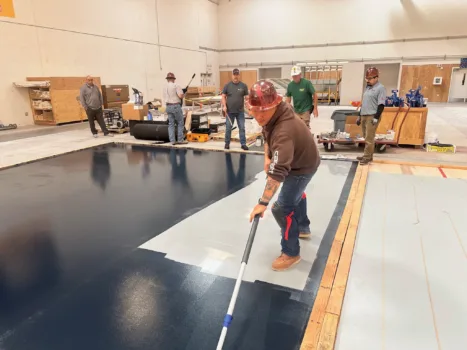
Pad-and-pour polyurethane flooring is a seamless, poured-in-place system made of a pad layer installed over a substrate and finished with a liquid-applied polyurethane topcoat. The pad layer, typically foam or rubber, is placed in a grid or mat configuration, and the polyurethane is poured or trowelled onto it to create a continuous, joint-free surface. Sometimes described as hybrid-elastic, i.e., a blend of point- and area-elastic, these systems are not all hybrid in performance; specifiers should not assume area‑elastic behaviour without first reviewing independent test results for shock absorption, vertical deformation, and ball rebound.
Depending on pad configuration, thickness, and system engineering, some systems exhibit limited load distribution, approaching hybrid-elastic behaviour. However, the actual performance depends on specific system design and verified test data rather than just the installation method.
Performance characteristics: Pad-and-pour polyurethane flooring provides strong shock absorption, durability, and surface uniformity suitable for a wide range of indoor athletic activities. The cushioned pad layer reduces impact forces on athletes, while the seamless polyurethane surface provides consistent traction and easy maintenance. Compared with sports vinyl, pad-and-pour systems are generally better at withstanding repeated multipurpose use. This is because the poured polyurethane surface forms a thicker, fully bonded wear layer that resists gouging, seam separation, and surface damage from chairs, staging, and rolling equipment. Unlike sheet vinyl systems that rely on welded seams and factory-applied cushioning layers, the monolithic construction of pad-and-pour floors reduces the risk of edge wear and seam failure in high-traffic areas. Compared with rubber flooring, pad-and-pour surfaces provide greater surface uniformity and more controlled athletic performance. Whereas rubber’s dense, point-elastic composition can create localized deflection patterns that vary slightly under different loads, which commonly results in reduced ball rebound and inconsistent ball response, limiting its suitability for basketball and volleyball programs, a properly engineered pad-and-pour system distributes loads more predictably through its configuration and continuous top layer. This can result in more consistent traction, smoother ball roll, and increased uniform vertical deformation across the playing surface.
Best uses: Pad-and-pour systems are well-suited for gymnasiums that host activities such as basketball, volleyball, assemblies, and social events. Its durability, shock absorption, and seamless appearance are ideal for schools, community centres, and multi-use athletic facilities where both sports performance and multipurpose flexibility are important. While it may not replicate the precise ball response of maple hardwood, it offers a balance of performance, safety, and versatility that meets the demands of diverse programming.
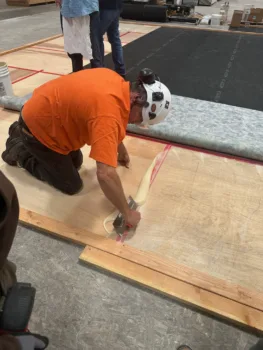
Installation implications: Meeting performance metrics depends on precise substrate preparation and pad installation. The slab must be level, smooth, and moisture-controlled to ensure proper adhesion and consistent vertical deflection, and pads must be accurately spaced and secured for predictable shock absorption. Since the polyurethane topcoat is poured and finished on-site, installers must ensure strict environmental control during curing to prevent bubbling, shrinkage, or uneven texture. Pad thickness, spacing, and polyurethane formulation also vary by manufacturer, so selecting an installer with manufacturer-specific training and installation certification is important to achieving desired performance outcomes.
No single gymnasium flooring system is inherently superior to another. The right choice is the one that best aligns with the project’s specific goals and realities.
Planning: The gymnasium floor checklist
Choosing a gymnasium flooring system requires evaluating how a space is expected to function and perform over its lifetime. For designers and specifiers, this means working with facility owners to define expectations and assess installation conditions to make the best choice. This early-stage planning checklist must include:
Athletic performance:
Shock absorption, vertical deformation, ball rebound, and traction are distinct characteristics of flooring systems, and each affects safety, fatigue, and game consistency. Surface friction should be verified using recognized testing methods, particularly in a multipurpose gymnasium under occasionally wet conditions. A common mistake is assuming a floor that works for casual play will meet competitive standards, but high-level sports demand high-level systems and installation with tighter tolerances and verified performance data.
Intended use:
The facility’s programming and frequency of use strongly influence material selection. Multipurpose gyms hosting assemblies, performances, or community events require floors that can withstand heavy foot traffic, rolling loads, and temporary seating without long-term degradation. A frequent mistake is underestimating non-sport uses, which can accelerate wear if the system is not robust enough to withstand them.
Durability and lifecycle expectations:
Consider how the floor resists scuffing, seam stress, and repeated reconfigurations. High-performance athletic surfaces require more controlled environments and disciplined maintenance to achieve a full lifespan, while more resilient systems tolerate heavy multipurpose use with less oversight. Overestimating lifespan without accounting for use intensity is a frequent cause of premature replacement.
Maintenance requirements:
Maple hardwood requires periodic sanding and refinishing to maintain traction and appearance, while sports vinyl, rubber, and pad-and-pour polyurethane generally only need routine cleaning or occasional recoating. Aligning the facility’s maintenance capacity with the flooring type is essential to preserving performance and extending service life.
Subfloor and structural conditions:
Slab flatness, substrate moisture levels, floor height, and load-bearing capacity can limit system options. Area-elastic constructions such as maple hardwood require greater build-up, whereas thinner resilient systems are often preferred in renovations with restricted clearances. Acoustics should also be considered, as impact and structure-borne sound can travel to adjacent spaces or floors. Proper subfloor design, underlayment selection, and pad placement can reduce noise transmission, especially in multi-level buildings, shared-use facilities, or gyms near classrooms, offices, or performance spaces. In multi-level buildings, flooring systems should be evaluated for impact sound transmission early in the design phase, as an acoustic consultant can help specify an appropriate pad, underlay design, or slab isolation details.
Budget and lifecycle cost:
Evaluate the flooring system’s total cost of ownership, not just its initial price. Upfront savings can easily be lost to higher maintenance, resurfacing, or premature replacement costs, especially when flooring is not fully aligned with intended use.
Esthetics:
Gymnasium flooring systems offer a range of colour, pattern, and surface texture options complementing a facility’s design. Maple hardwood provides natural wood tones and can incorporate custom inlays and striping for courts. Sports vinyl and rubber can include integrated graphics, logos, or contrasting zones for multi-sport layouts, and pad-and-pour polyurethane systems offer seamless colour application and subtle surface textures. Considering the visual possibilities alongside functional requirements ensures the floor enhances both the space’s look and usability.
Standards and compliance:
Ensuring a gymnasium floor meets recognized performance standards is a key part of specifying a reliable system. One internationally recognized benchmark is ASTM F2772, Standard Specification for Athletic Performance Properties of Indoor Sports Floor Systems. This standard defines minimum criteria for performance measures, along with test methods to measure these properties.
Examples of ASTM F2772 measures include:
Shock absorption: The floor must absorb at least 25 per cent of the impact force compared to a rigid concrete reference surface. Higher values indicate greater protection for athletes.
Vertical deformation: The minimum is 2.3 mm (0.09 in.). This measures how much the floor surface deflects or gives under a standard impact load.
Ball rebound: The floor must return the ball to at least 90 per cent of the height it would reach on a rigid concrete surface.
Surface friction: A coefficient of friction between 0.4 and 0.7. This range supports athlete traction without creating excessive grip that could cause injury.
Energy restitution: This measures how much energy the floor returns to the athlete after impact. The minimum is 25 per cent.
ASTM F2772 classifies indoor sports floors based on the forcereduction (shock-absorption) they provide relative to a rigid surface (e.g., concrete). The classification is not arbitrary. It defines how the system behaves under athletic load.
Class 1
System behaviour: Minimal resilience, feels firm, and closer
to concrete.
Typical construction: Direct-fixed or very limited resiliency
systems.
Implication: Lower comfort and higher impact stress on
athletes. Generally not appropriate for high-level competition.
Class 2
System behaviour: Balanced response between firmness
and give.
Typical construction: Sleeper systems with resilient pads
or cushions.
Implication: Suitable for multi-use school gymnasiums.
Acceptable compromise between performance and cost.
Class 3
System behaviour: High energy absorption with controlled
ball return.
Typical construction: Advanced resilient systems ( foam pads,
engineered subfloor systems).
Implication: Designed for high-performance athletics. Reduces
athlete fatigue and injury risk.
These classes provide a structured way to align floor selection with the demands of the intended sport and level of play. The best practice is to work closely with the flooring system manufacturer and the installer to identify applicable standards, incorporate them into the installation plan, and verify compliance through third-party testing after installation. This approach provides independent confirmation that the floor delivers the intended level of performance, protecting athletes and preserving the longterm integrity of the system.
Certified installation:
Sports flooring systems are highly specialized projects, and their manufacturers require certified installers to ensure their systems meet warranty conditions and deliver precisely engineered performance. Specifying their required credentials early in the project and seeking installers with certifications from industry recognized training organizations helps ensure the floor is installed correctly, maximizes long-term performance, and protects both the owner’s investment and athlete safety.
Selecting the right gymnasium flooring means aligning the material, performance characteristics, and installation approach with the full spectrum of a facility’s goals. Maple hardwood, sports vinyl, rubber, and pad-and-pour polyurethane each offer strengths and limitations. By carefully considering the facility’s unique needs and conditions, design teams can make informed choices that ensure the modern gymnasium supports both athletic programs and the broader community activities that define its role.