
*This article by INSTALL executive director David Gross was originally featured in Floor Covering News Magazine.
INSTALLments: A Series on the Challenges & Opportunities in the Floorcovering Trade
Scribing Wood Flooring: Why Patience Pays Off
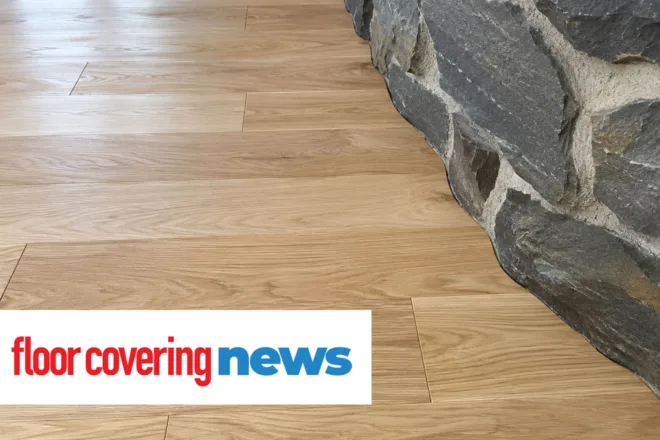
Fitting wood flooring around an irregular surface requires more than a steady hand and a sharp tool. Unlike cuts that will be concealed by trim or other elements, scribing transfers an irregular profile onto a plank that will often remain visible. Whether fitting flooring against a jagged stone fireplace or other irregular obstruction, the process requires several distinct competencies. Taking care and practicing patience at each step helps prevent rework and wasted material.
1. Verify the layout. Before marking the plank, determine its final position, joint placement, and grain orientation. The goal is to achieve a clean fit without creating an impractical sliver or failing to maintain the expansion gap requirement. Marking a plank before confirming its placement might produce an accurate cut but not an acceptable finish, potentially requiring a replacement plank or compromising the overall layout.
Tip: Always confirm the plank’s placement prior to marking so the finished cut aligns with the intended composition.
2. Establish the offset. Position the plank and adjust the compass, scriber, or marking gauge tool to transfer the contour while maintaining the expansion clearance. The offset determines how closely the plank follows the surface and how much space remains for movement. An inconsistent offset can leave excessive gaps in some areas and an overly tight fit in others.
Tip: Check the tool setting often to maintain consistency and achieve a uniform fit along the entire profile.
3. Transfer the profile. Keep the scriber perpendicular and maintain a consistent offset while moving the marking tool along the obstruction. Even a slight change in the tool’s angle can distort the transferred profile.
Tip: A pinpoint mark provides a more precise reference than a broad pencil line.
4. Cut. Select the appropriate cutting tool, such as a jigsaw, coping saw, oscillating tool, band saw, hand tool, or a combination, depending on material and cut complexity. Note which side of the scribe line the blade follows, accounting for line width.
Tip: In tight-fitting applications, a fine mark and controlled cut will preserve enough material for final adjustments.
5. Back-bevel complex fits. To make a complex profile easier to fit without binding beneath the surface, slightly relieve the underside of the cut so the visible top surface establishes the primary finish point.
Tip: Keep the bevel controlled and shallow at 1 to 3 degrees to preserve edge integrity and allow the visible face to establish the fit.
6. Fine-fit the edge. After rough cutting, switch to smaller, more controlled tools, such as a plane, rasp, chisel, file, or sandpaper to refine the profile. Remove material incrementally, checking the fit between adjustments.
Tip: Making tiny adjustments with a large cutting tool risks removing too much material, damaging the edge, and introducing safety risks. Incremental adjustments with small tools offer greater precision and control.
7. Verify fit and movement. Test-fit the plank, inspect the visible edge, and confirm the required expansion space is consistent with the manufacturer’s instructions and installation system.
Tip: Balancing a close fit with the manufacturer’s specified expansion space maintains compliance and mitigates risk of flooring failure.
Scribing is a series of interconnected skills, and early mistakes can quickly compound as work progresses. Careful layout, consistent marking, controlled cutting, and patience during fine-fitting help installers achieve cleaner results with less wasted time and material.

David Gross is executive director of INSTALL, the leading organization for floor covering installation training and certification in North America. Prior to this role, he was a full-time instructor for the Eastern Atlantic States Carpenter’s Apprenticeship Training Fund, where he achieved Level III Advanced Instructor Certification. Gross holds a bachelor’s degree in economics, an MBA and is a BCSP Certified Safety Professional with more than 30 years of hands-on flooring installation experience.