
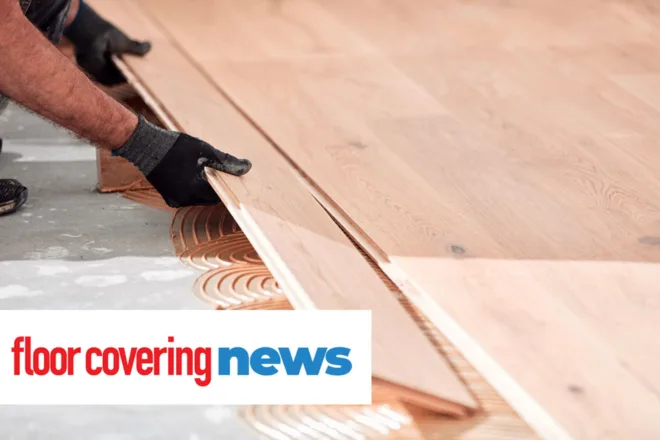
*This article by INSTALL executive director David Gross was originally featured in Floor Covering News Magazine.
INSTALLments: A Series on the Challenges & Opportunities in the Floorcovering Trade
Pattern Matching: Two Challenges, One Floor
By David Gross, Executive Director of INSTALL Flooring
Walk through enough commercial and residential installations and a pattern emerges, not on the floor, but in how problems occur. A seam that looked right during installation appears broken once the room fills with light. A random plank layout that felt balanced during placement visually clusters in one corner. No matter where the mismatch occurs, the problem often arises from the same cause: pattern matching was treated as one challenge when it is actually two.
Challenge One: Material Pattern Matching
Whether working with carpet tile, broadloom, or resilient flooring, material pattern matching means ensuring directional arrows, dye lots, grain direction, and visual repeats align across every seam and transition. The result should read as a continuous, uninterrupted surface, even across hundreds of pieces.
While material pattern matching is largely procedural, it still requires careful attention to maintain consistency across the installation. Failure here is unforgiving. Even minor deviations can introduce broken lines or visual noise, and one misread repeat can create material shortages mid-job.
Challenge Two: Floor Pattern Execution
In addition to material patterns, layouts like ashlar, herringbone, chevron, brick offset, and other parquets introduce geometric orientation rules, sequencing logic, and tolerance requirements. Here, a substrate imperfection or single placement error can set off a visual disruption across the field, producing misalignment, noticeable runoff, and inconsistent perimeter cuts by the time you reach the far wall.
Field measurement and advance planning are essential, and reading the room means more than establishing reference lines. Understanding how the finished floor will be perceived through sightlines, entry points, and lighting all influence how patterns (and pattern errors) are experienced. That perceptual thinking must happen before installation begins.
The Hardest Case: Random Patterns
Random layouts common in hardwood, plank, and mixed-color tile installations are among the most demanding to execute. A specification might call for a white field tile supplemented by 10% red, 20% yellow, and 30% blue tiles distributed throughout the space. On paper, it’s straightforward. But in the field, it requires meeting two competing objectives simultaneously: preserving the specified color ratio across the installation and preventing clustering of any single color or grain.
The difficulty is structural. Installation happens piece by piece, but the pattern must read as a whole, in an empty room, and without furniture and lighting in place. That means the installer must anticipate how distribution will appear from the final, lived-in perspective. It requires pattern thinking, not just pattern following.
Experienced installers develop systematic approaches to manage this, pre-staging materials and mapping floor sections before a single piece is set. Working in grids or zones also helps ensure each area meets the ratio before moving forward. Conducting visual inspections, continually stepping back, checking distribution, and making micro-adjustments as the project progresses are also best practice. The goal is not mathematical perfection. It’s visual balance. Random does not mean arbitrary.
The Common Thread
Across all pattern-matching scenarios, the underlying principle is the same: the eye detects inconsistency. Successful pattern matching is a refined skill set that recognizes both material pattern and execution, controlling visual balance through planning and judgment. That is the standard. And meeting it is what makes an installer a craftsperson.

David Gross is executive director of INSTALL, the leading organization for floor covering installation training and certification in North America. Prior to this role, he was a full-time instructor for the Eastern Atlantic States Carpenter’s Apprenticeship Training Fund, where he achieved Level III Advanced Instructor Certification. Gross holds a bachelor’s degree in economics, an MBA and is a BCSP Certified Safety Professional with more than 30 years of hands-on flooring installation experience.