*This article by INSTALL executive director David Gross was originally featured in ProInstaller Magazine.
From Peewees to Pros, the Sports Flooring Field Is Wide Open for Certified Installers
North America’s investment in sports and fitness facilities is booming, and that means plentiful opportunities for certified installers with specialized training in sports flooring. Synthetic turf, maple hardwood, rubber/resin, and pad-and-pour installers are in particularly high demand, as manufacturers continue to innovate with products and systems that are safer, more shock absorbent, and more sustainable. Whether you’re a newcomer seeking a stable career or a seasoned contractor looking to upskill, specializing in sports flooring offers significant advantages in a lucrative market with relatively low competition.
Playing the Field: Why Certification Matters
With skilled labor in short supply across the flooring industry, stepping into the sports flooring sector can quickly move a career forward in a market hungry for trained talent. It does, however, require a highly technical skill set to succeed, and certification is increasingly the key to success, especially for high-profile professional sports and publicly funded projects.
Organizations such as the International Standards & Training Alliance (INSTALL) offer comprehensive sports flooring programs that are built on foundational commercial flooring training. The standard curriculum covers the full lifecycle of a sports flooring project, from core technical skills, surface specialization, and manufacturer-specific products and systems to industry standards, documentation, and safety and compliance. This training prepares installers to meet the rigorous performance, testing, and administrative demands that set sports flooring apart.
Compared to typical residential or commercial jobs, sports flooring projects carry significantly higher stakes. Facility owners and contractors are responsible not only for ensuring player safety but also for meeting sport-specific performance criteria. These projects also represent substantial financial investments, so owners often specify certified installers to protect warranties and avoid costly callbacks. Similarly, certification is mandatory for publicly funded work to ensure installers can meet the technical, documentation, and compliance standards tied to state or federal funding.
Documentation distinguishes sports flooring from other sectors. School and university projects, for example, often require detailed submittals, moisture and flatness testing reports, product data sheets, performance test results, and closeout packages to prove installations meet ASTM standards, manufacturer specifications, and the standards of the sport. Many floors must pass formal field tests for shock absorption, ball rebound, and surface friction before they’re accepted. A failed test can delay payment, void warranties, or require costly rework. For this reason, owners and general contractors rely on certified teams that are trained not just to install the floor but to manage the entire compliance process from start to finish.
This full scope of skills is what separates certified sports flooring installers from their non-certified counterparts. While traditional residential and commercial installers may enter the market with on-the-job training, the stakes in sports flooring are too high and the technical requirements too complex to rely on informal instruction. Ultimately, certification is what turns capable installers into trusted specialists in a high-stakes, high-reward market.
Where Skills Meet Opportunity
Once installers understand the compliance, testing, and performance expectations behind sports flooring, the next step is choosing where to specialize. Certified crews are in demand across multiple surface categories, each with its own techniques, tolerances, and applications. The good news is that for many residential and commercial installers, moving into sports flooring is an evolution of existing skills, not a reinvention. Three in-demand sports flooring systems—synthetic turf, maple hardwood, and resin/rubber—capture key opportunities in the sports flooring market, demonstrating how familiar installation skills can transition to high-performance projects.
Synthetic Turf
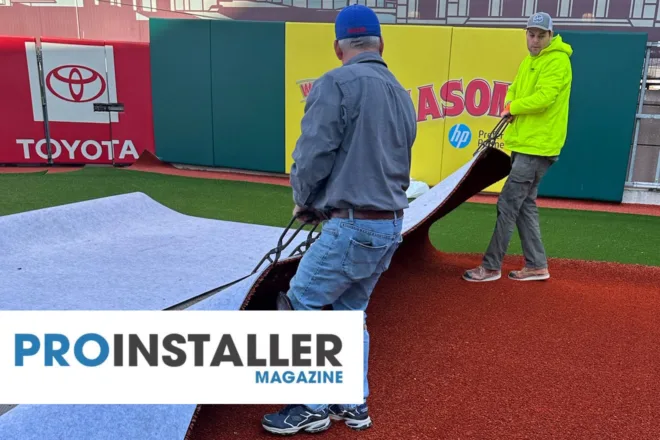
Synthetic turf is a system of engineered layers that replicate natural grass for fields that can be used longer across more seasons. Installation starts with a graded, compacted, and well-draining stone base (analogous to subfloor prep), and many projects add a foam or rubber shock pad for impact attenuation. The top “carpet” layer comprises tufted synthetic fibers (typically polyethylene) on a perforated backing that is rolled out, trimmed, and seamed by gluing or sewing. Infill, commonly sand and elastomer granules, is distributed between the fibers to hold them upright and fine-tune game performance such as player traction and ball roll. Newer no-fill synthetic turf is also gaining traction and demands even greater seaming precision. Synthetic turf is ubiquitous in professional and collegiate sports such as football and soccer. It is also popular for year-round, multi-sport indoor training centers.
Traditional skills applied:
-
-
- Seaming, trimming, and adhesive work are similar to commercial carpet installations
- Site preparation and grading techniques
- Layout and measurement accuracy
-
Specialized skills required:
-
-
- Precision base preparation and drainage design
- Specialized turf seaming and gluing methods
- Accurate infill placement and sport line layout
- Understanding shock pad systems and performance tolerances
- Meeting multiple ASTM standards for impact attenuation, shock absorption, and vertical deformation
-
Synthetic turf is a logical transition for commercial carpet installers and concrete pros.
Maple Hardwood
Maple hardwood floors for sports such as NBA and WNBA basketball and professional volleyball are multi-layer wood systems designed for uniform ball response, traction, and resilience. The finished surface is MFMA-grade northern hard maple installed over a subfloor assembly that can include sleepers with resilient pads, plywood layers, and other performance components. After fastening the strip maple, the floor is sanded, sealed, and painted with sport-specific game lines and logos. Maple hardwood floors are also used in K–12 gymnasiums, collegiate competition, and recreation facilities.
Traditional skills applied:
-
-
- Subfloor prep, fastening, and layout
- Humidity testing and acclimation
- Sanding, finishing, and coating
-
Specialized skills required:
-
-
- Achieving tight flatness tolerances over large spaces
- Stricter environmental control to manage wood movement
- Multi-sport line layout
- Broadcast-quality finishing and line and logo work
- Meeting ASTM F2772 and MFMA standards for performance and materials
-
Maple hardwood sports flooring is a natural fit for residential or commercial hardwood installers experienced in high-precision layouts.
Resin/rubber
Resin/rubber floors are site-built systems made using a rubber base mat and liquid polyurethane (pad-and-pour) or by pouring polyurethane, epoxy, or other resinous coatings over a troweled-on mixture of rubber granules and a binder. Liquid polyurethane bonds directly to the rubber base, creating a smooth, flat surface. After curing, the surface is sealed, finished, and lined for sport-specific play. Resin/rubber and pad-and-pour systems are widely used in K–12 multipurpose gymnasiums, college fieldhouses, and athletic, fitness, and weight training centers.
Traditional skills applied:
-
-
- Surface prep, leveling, and moisture mitigation
- Adhesive and compound mixing
- Troweling and finishing skills used in resinous or self-leveling underlayment work
-
Specialized skills required:
-
-
- Accurate mixing ratios and application techniques for resin systems
- Controlling ambient conditions during cure
- Building up layers to meet shock absorption and performance specs
- Working to tight substrate tolerances
- Installing different manufacturer systems to meet ASTM F2772 performance classifications
-
Resin/rubber is a natural upskill for commercial and residential resilient installers with self-leveling underlayment experience.
These sports flooring examples take familiar installation skills to the next level with specialized materials, techniques, and performance standards that make them challenging and rewarding.
Bringing Your A-Game
Certification is always the right play for a rewarding, future-proof career in professional flooring. Through programs like INSTALL’s comprehensive sports flooring curriculum, installers gain the hands-on experience, technical knowledge, and documentation skills needed to succeed. INSTALL-certified installers have the privilege of working at every level of sports, from community gyms to NFL turf fields for the Philadelphia Eagles and the Minnesota Vikings. As demand for safer, higher-performing athletic spaces continues to grow, certified professionals will be in the best position to lead the charge and set new standards of excellence on every field, court, and track they touch.