
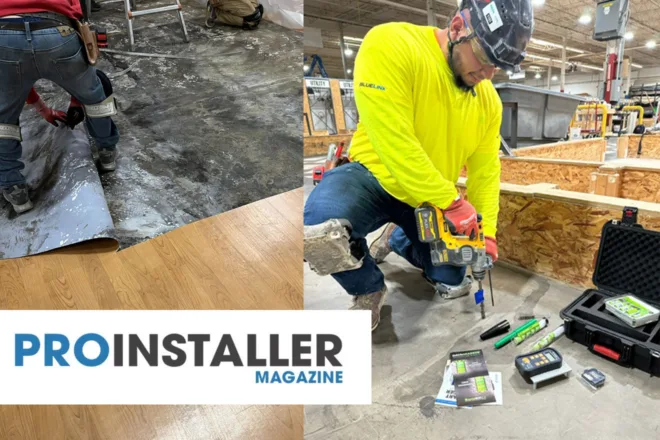
*This article by INSTALL executive director David Gross was originally featured in ProInstaller Magazine.
Concrete Moisture Control and Remediation: What’s the Difference?
Whether installing flooring on a new concrete slab or performing a tearout and replacement on an existing one, moisture is always a concern. Despite all that is known about moisture control and concrete, and cautionary tales of the billions of dollars lost each year on moisture-related flooring failure, the problem persists.
Why? What is the difference between concrete moisture control and remediation? And what can installers do so they don’t become part of a billion-dollar statistic?
To answer these questions and get expert insight into the challenges of installing flooring over concrete slabs, we consulted INSTALL Master Instructor Tracy Yanske of the Carpenters Training Institute, Technical Field Supervisor Daniel Grant of ARDEX Americas, and Sales Professional Ben Bieker of ARDEX Americas to provide insight into the issue.
Q: Why has moisture continued to be a problem for installers working on concrete slabs?
Yanske: Moisture-related failures are usually traceable to three main causes: a lack of knowledge and training on subfloor preparation and concrete, inexperience with the requirements of different moisture control products and flooring materials, and the pressures of fast-track construction.
Concrete slabs alone demand a certain depth of understanding about moisture vapor emission rates (MVER), relative humidity, pH, cure times, and other variables that impact the final flooring. Add to that the technical requirements for products that are applied to control moisture coming out of the slab and the specs for the final flooring material, and you begin to see how many opportunities there are for missteps.
In a perfect world, all project contributors, including the architect and the GC, would understand these variables and manage their part of the process to account for them. But too often, that is not the case. Installers are the last contractors in line. As such, they bear the responsibility for the success or failure of the installation. Ideally, installers should test every jobsite to assess the slab’s moisture conditions and readiness for flooring, but the fast pace of new construction often does not include the time or the budget to cover the essential steps for best practice.
Q: What is the difference between moisture control and moisture remediation?
Grant: Moisture control is what you do proactively at the beginning of a project to ensure the slab can successfully receive the flooring. It includes allowing time for proper curing, testing site conditions for MVER, humidity, and pH, and in some cases applying moisture control products like single-component or two-part epoxy to handle the expected moisture load.
Moisture mitigation is the corrective action taken to bring an out-of-spec slab back to a condition suitable for flooring. Ideally, if the moisture control steps are properly managed, then any moisture mitigation is minor and occurs prior to the installation of the final flooring. In worst case scenarios, moisture remediation takes place after finished flooring installation due to some form of flooring failure. That failure may be in the flooring not properly adhering, or it may be in the moisture control system itself if it was not applied according to manufacturer specifications.
One way or another, installers have to deal with moisture when working on a concrete slab, and it’s much less costly to control potential moisture issues from the start than to correct them after there’s a problem.
Q: What should every flooring pro know about moisture and concrete slabs?
Yanske: From a professional skills and training perspective, best practice is testing every slab to confirm its readiness before accepting the site and starting installation.
A GC may tell an installer a slab is ready, but that GC may not be knowledgeable enough about concrete and moisture conditions to make that determination. A slab can appear dry on its surface but still contain a lot of moisture that will eventually work its way out.
Likewise, if the worksite is open to the elements, it can be exposed to rain and humidity, or one of the other trades could inadvertently track something onto the slab. Even simple things like whether the HVAC system is operating properly can have an impact on the flooring outcome.
The point is installers don’t know what the slab has been exposed to prior to their arrival, so taking someone else’s word for the condition of the slab is an incredible gamble.
Grant: As a technical expert for a moisture control and remediation product manufacturer, my recommendation is always for installers to read the manufacturer’s data sheets and application instructions for the specific products they’re using and follow them to the letter. Doing that ensures the product will perform as expected, and it helps protect the warranty.
With so many new products being introduced all the time, installers shouldn’t assume that all two-part epoxy systems or all single components have the same specs. Material technologies and formulations are constantly changing. Installers who treat every job the same as the last or take short cuts to get the job done faster are putting themselves at risk.
For example, I was recently called to a jobsite where a flooring installer used a cup grinder instead of shot blasting to prep a slab for an epoxy moisture mitigation system that specified a CSP 3. Cup grinding can deliver a CSP 1, or CPS 2 at best. As a result, the epoxy was essentially sitting on top of the concrete instead of gripping into it. The slab lacked sufficient texture for the epoxy to bond properly. It was a serious installation error, and, unfortunately, that one wrong choice to use a cup grinder meant the installer had to tear up and start over.
Q: What advice would you give to installers to protect themselves from moisture-related liabilities?
Yanske: The simplest thing an installer can do to avoid moisture problems is to perform their own tests to confirm the slab is ready for installation.
First, visually inspect the worksite. Before any work begins, walk the slab and look for dark, damp areas. If materials packaged in plastic are stored on the slab, lift them up and check for dampness underneath. If excess moisture is present, a visual check will provide the first clues.
Next, conducting a comparative moisture RH scan using a non-destructive meter as per ASTM F2659 can identify problem areas or where further testing should take place. However, most manufacturers currently recognize relative humidity as the key indicator of a slab’s long-term moisture behavior as per ASTM F2170. This is measured with an in-situ test to determine an accurate measure of the relative humidity inside the slab. The RH reading reveals what moisture emission potential exists within the slab, and the measured RH must be within a certain range to prevent adhesive failure.
pH testing that conforms to ASTM F710 can also save an installation. Installers can use simple pH test strips or handheld digital meters to measure the alkalinity of the concrete surface. High pH often goes hand in hand with high moisture. When alkalinity is too high, it breaks down flooring adhesives and causes discoloration or staining—problems that would show up later if the condition is not corrected.
When installers are using adhesives or other products with strict moisture vapor emission limits, then MVER testing that conforms to ASTM F1869 is required. The test measures how much moisture vapor is emitted from the slab surface. It’s expressed in pounds per 1,000 sf per 24 hours. If the emission rate is too high, for example above three to five pounds, it can cause adhesives to re-emulsify, create bubbling under the flooring, and even lead to failure of self-leveling underlayments.
Each test requires an installer to know the specifications of the products they’ll be applying and to ensure slab conditions meet those requirements. It is definitely not a scenario in which you want to rely on someone else saying the slab is good to go. It requires a high degree of technical acumen and precision, and it’s the primary reason INSTALL partners with product manufacturers to inform our curriculum and hands-on training. INSTALL and the Carpenters Training Centers teach testing and installation skills, and our many manufacturing partners like ARDEX provide product expertise. Having these partnerships is essential for us to ensure what we teach continually aligns with material advances.
Bieker: Manufacturers also offer free product training for installers, and for the architects and GCs who specify the products and oversee the installations. The more we engage people at every level of the process, the more we raise the chances for success.
Q: What is the one most important thing you want every installer to know?
Yanske: Once you begin work on a site, you have accepted its condition and are accountable for the outcome. Protect yourself by performing your own tests to verify conditions are acceptable. If the slab is out-of-spec, report it to the GC.
Bieker: Take advantage of manufacturer training for the products you use. It’s free, and it’s typically a one-day commitment. You are the installation expert. The manufacturer is the product expert. You need both types of expertise for success.
___________
Tracy Yanske is an INSTALL instructor at the Carpenters Training Institute in Altoona, IA, and an INSTALL Master Instructor at the UBC International Training Center in Las Vegas, NV. Tracy has 28 years of flooring experience with the Carpenters Union Local 106 as well as many years prior in residential and commercial flooring expertise.
Daniel Grant is a technical field supervisor at ARDEX Americas. He holds several industry certifications, including FCICA’s Certified Installation Manager (CIM), CTEF’s Certified Tile Installer, ICRI’s Moisture Testing Technician, and NAFCT’s Substrate and Subfloor Prep Certification, and he is actively involved with CTEF, FCEF, FCICA, ICRI, INSTALL, NAFCT, NFCAP, and NTCA. His areas of expertise include tile and stone installation, concrete repair, moisture in concrete, proper substrate preparation, underlayments, concrete overlays, and adhesives.
Ben Bieker is a sales professional at ARDEX Americas with nearly 10 years of service serving the Upper Midwest. He was an installer for 15 years, and 2026 marks his 25th year in the flooring industry.
This collaborative discussion on the topic of concrete moisture control and remediation is the result of INSTALL’s long-time partnerships with the leading manufacturers that serve the flooring industry. ARDEX Americas is one of more than 130 partners that regularly consult with INSTALL to develop and maintain a cutting-edge curriculum that reflects up-to-the-minute materials, technologies, and best practices in the flooring industry. To learn more about INSTALL, its manufacturing partners, and its training and certification curriculum, visit installfloors.org.